
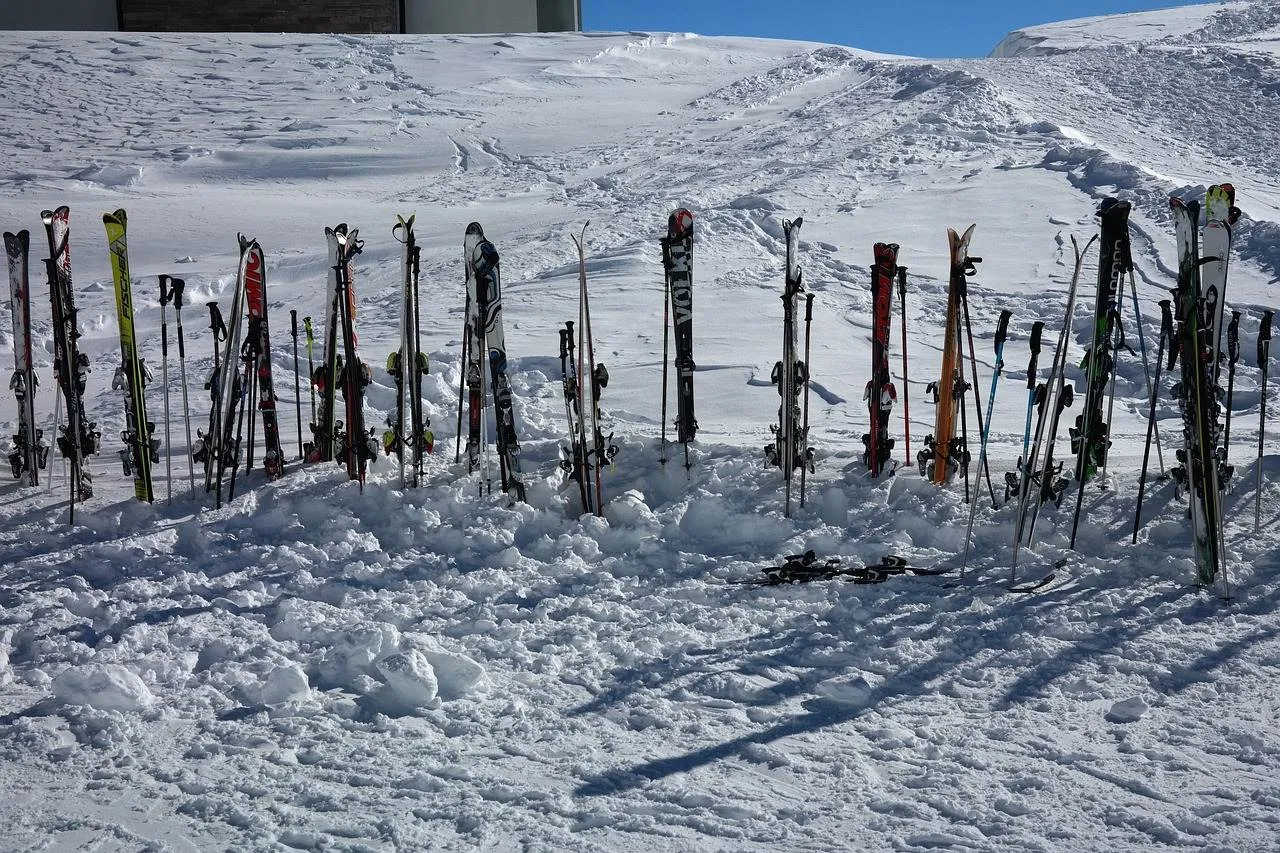
Long before they became synonymous with winter sports and freedom in the snow, skis were a survival necessity. Born thousands of years ago, not for fun but to cope with winter, these two simple tools have spanned the centuries, transforming into a symbol of speed, technique, passion and connection with nature.
Today, skis hurtle down slopes all over the world, but their history has ancient and surprising roots.
When it all began: skiing in prehistory
The first skis were born not in Alpine resorts nor in the snowy Alps, but among the dense forests of northern Asia and Scandinavia. About 8,000 years ago, Norse peoples began using long, flat wooden boards to move across frozen lakes and deep snow. They were tools for hunting, survival, and travel.
In rock paintings found in Norway and Russia, human figures with long elongated feet can be glimpsed: they were rudimentary skis. And they had nothing to do with sports. They were the winter equivalent of wheels.
From tool to companion: traditional skiing
For centuries, skiing remained a means of winter transportation. Sami peoples in the Arctic lands developed advanced techniques for building skis from birch and bentwood, binding them to their feet with reindeer skins.
Regional differences were great: some skis were long and narrow, others short and wide, depending on the environment. But everywhere, skiing meant mobility. It was autonomy against snow, communication between villages, hunting, transportation, survival.
The birth of modern skiing
The turning point occurs in the 19th century. In Norway, skiing from a means of transportation becomes sporting activity. Accomplice to a mountain-related culture and a growing spirit of challenge, the first cross-country ski races and the first descents for fun.
In 1868, the first documented ski race was held in Oslo. From there, skiing conquers the Alps, the Carpathians, and the Rocky Mountains. English and German tourists bring skiing to Alpine resorts, and with them come the first ski schools, instructors, dedicated equipment.
In 1924, skiing officially debuted at the Chamonix Winter Olympic Games: It is the beginning of a new era.
Technology, speed, entertainment
During the twentieth century, skiing evolves dramatically. From solid wood structures, there is a shift to materials such as steel, plastic, and carbon. The Alpine skiing, slalom, freestyle, ski jumping. Each discipline tells a different way of experiencing the mountains.
Skiing is no longer just a sport: it is show, tourism, cultural identity. Ski resorts become global destinations. Great athletes - from Ingemar Stenmark to Lindsey Vonn - become legends. And millions of fans recognize themselves in the ancient act of gliding across the snow.
Skiing today: between tradition and innovation
Today, skis are advanced engineering products: lightweight, high-performance, custom-made. But they still carry the legacy of the first Siberian hunters. Every turn on a slope, every step in cross-country, every flight in freestyle is a dialogue between the human body and winter.
Skiing continues to be a bridge between worlds: between past and future, between nature and technology, between solitude and community. Because skiing, after all, is not just sport: it is experience, memory, freedom.



 Italiano
  English
  Русский
  Français
  Deutsch
  简体中文
简体中文 