
There is a magical moment in every ice event when everything stops. The skaters retreat, the field hockey players go to the bench, and the noise of the arena subsides to make way for a gentle, hypnotic rumble: enter the the ice-making machine. That large, almost silent vehicle that dances on the track, leaving behind a surface as smooth as a mirror. But how does it really work? How much does it cost? And why is it often called "Zamboni"?
An invention that comes from California: the birth of the Zamboni
The idea was born almost out of necessity in the 1940s. Frank Zamboni, the son of Italian immigrants, ran a skating facility in Paramount, California. Each time the ice had to be resurfaced, it took more than an hour, four operators and a series of manual steps. Too long, too expensive, too tiring.
In 1949, Zamboni patented the first ice rink sanding machine: a kind of modified tractor that scraped the ice, collected the residue, and re-wetted it with hot water to create a new smooth surface. A revolutionary system. His company, the Zamboni Company, became a global brand, to the point that the name "Zamboni" today is often used to refer to any similar machine, even from other manufacturers.
How does an ice-making machine work?
The ice maintenance machine-whether it is a Zamboni or another brand-accomplishes four fundamental operations In one step:
- Scraping: a blade removes the uneven layer of worn-out ice.
- Collection of scraped ice: Chips are sucked up and collected in a container.
- Washing: The ice is washed with hot water to remove impurities.
- Regeneration: a layer of hot water is evenly distributed and freezes, creating a new perfect surface.
Modern machines are equipped with computerized systems to regulate thickness, temperature and humidity, and are increasingly electric or hybrid, to reduce environmental impact.
How much does an ice-making machine cost?
Costs vary widely by model, size, and technology. Indicative:
- Basic model (diesel or propane gas): €80,000 to €100,000
- Electric model: 100.000 - 140.000 €
- Automated models with AI or assisted driving: even over 160,000
Added to these are the maintenance costs, i energy consumption, l'water used and the runway refrigeration costs same.
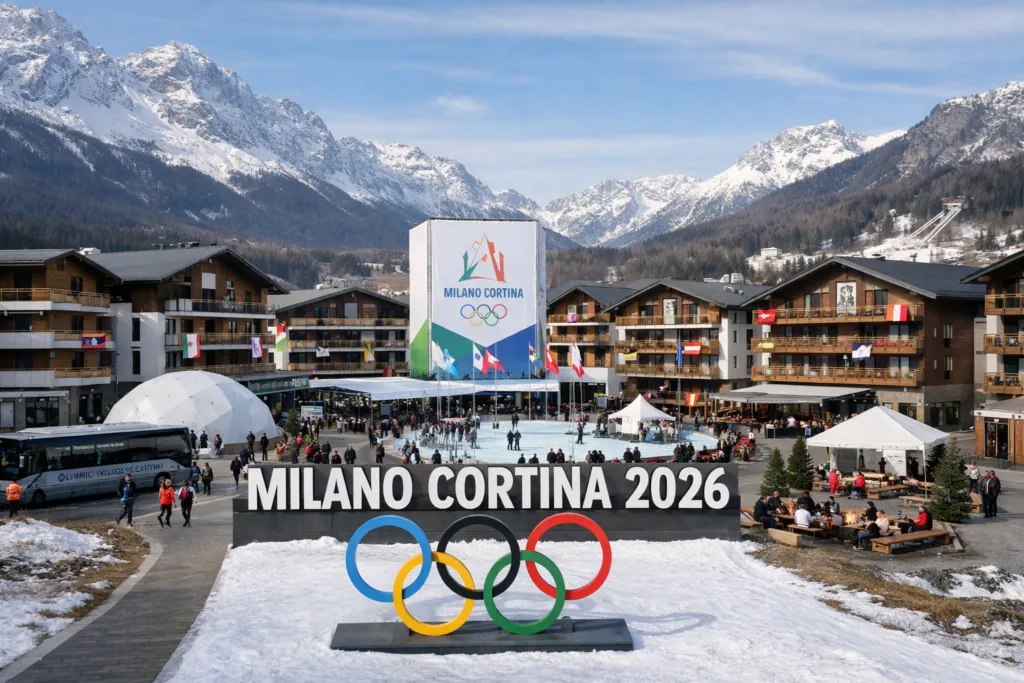
For Olympic facilities such as those in Milan Cortina 2026, are used advanced zero-emission versions, in line with the Games' environmental sustainability strategy.
What about the rest of the world? Alternatives and competition
Today Zamboni is no longer the only manufacturing company. Brands such as:
- Olympia (Canada)
- WM Ice Technics (Italy and Austria)
- Resurfice Corp.
produce similar versions, often with specialized features. Some tracks use intelligent robots for small areas, or continuous ice maintenance systems, which do not require the interruption of the sports session.
In Asia, some arenas are experimenting hybrid self-driving cars, operated by AIs that learn the optimal movements based on the type of event (figure skating, field hockey, curling...).
The magic behind ice sports
Whether it is the spectacular para ice hockey final or the skaters' pirouettes, no performance would be possible without that brief, silent appearance of the white giant smoothing the ice. It is an invisible but essential work, a hidden technology that underpins the beauty and agonism.
And now that we are approaching the Winter Olympics Milan Cortina 2026, these machines will not only be technical tools, but symbols of precision, evolution and efficiency Behind each medal.



 Italiano
  English
  Русский
  Français
  Deutsch
  简体中文
简体中文 