
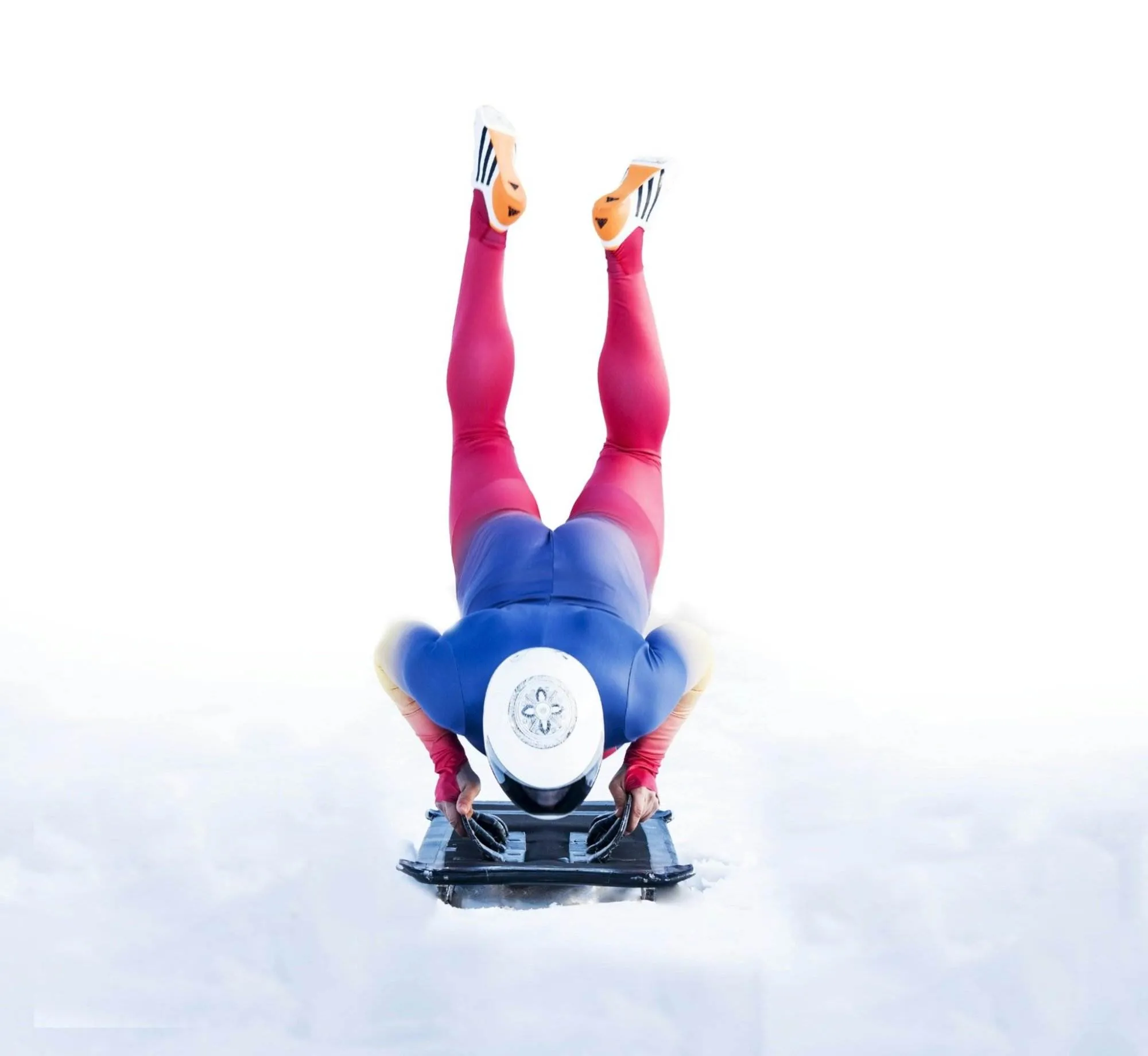
Imagine throwing yourself down an icy slope more than a kilometer long, with no brakes, no protection, face down, on a sled the size of a backpack. Ice slides inches from the face, turns come in at 5G of lateral force, and speed exceeds the 140 km/h. This is not an action movie, it is the skeleton, the most extreme and crazy sport of the Winter Olympics.
🧊 Origins: from Cresta Run to the world.
Skeleton was born where many winter disciplines took their first steps: in St. Moritz, Switzerland, in the 19th century. In 1884, the legendary Cresta Run, a natural ice rink destined to become the world center of the new sport. The British, regular guests at Swiss alpine resorts, fell in love with it and began to practice it with a certain passion--and a taste for risk.
The name "skeleton" comes precisely from one of the first metal sleds used: it was so skeletal and minimalist that it resembled ... a skeleton.
The skeleton made its first Olympic appearance in 1928 (right in St. Moritz), then disappeared, only to reappear there again in 1948. But it was only in the 2002, in Salt Lake City., which finally became a permanent Olympic discipline, with competitions both male and female.
🏁 How to compete: apparent simplicity, hidden technique
To look at it, it all seems very simple: an athlete pushes the sled for a few meters, dives onto it, and comes down at full speed. In reality, behind every turn is painstaking study, hours of training, and uncommon courage.
Basic rules:
- It starts with a brief push start, very important for gaining initial speed.
- Then we lie down belly down on the sled, with his chin inches from the ice.
- You don't drive with a steering wheel, but with Micromovements of shoulders, knees and body pressures.
- Every mistake is paid for: a trajectory departure can slow down, or worse, destabilize the athlete altogether.
An Olympic competition involves. two rounds (or four, for large events), and The one with the lowest overall time wins.
🚀 Speed, G-Force, and Real Risk.
Skeleton is a sport that constantly flirts with the limit. Athletes reach speeds approaching the 145 km/h, and in tighter curves they can suffer lateral forces up to 5G. For comparison: this is what a fighter pilot suffers on maneuvers.
Despite the apparent danger, skeleton is surprisingly safe thanks to modern safety measures, the precision of the slopes and the experience of the athletes. But the margin for error remains as thin as a blade of ice.
🌍 Who dominates the scene
Skeleton is still a niche sport, but very popular in Germany, Britain, the United States, Canada, South Korea and China. These are nations that invest heavily in technology, coaching and facilities.
Some names that have made history:
- Martins Dukurs (Latvia): one of the most successful ever, but without Olympic gold (kind of like Valentino Rossi with F1).
- Lizzy Yarnold (Great Britain): double Olympic gold medalist, a symbol of coolness and concentration.
- Yun Sung-bin (South Korea): the "superhero in the Iron Man mask," gold in PyeongChang 2018.
🇮🇹 What about Italy? On the launch pad
Italy in skeleton has not yet won Olympic medals, but participation is growing, especially as the Games in Milan-Cortina 2026. Athletes such as Amedeo Bagnis e Valentina Margaglio are bringing visibility and good results in the World Cup, paving the way for a new generation.
🧠 Why follow it
Because it is adrenaline, essential, spectacular. There is no time to think: the race lasts less than a minute. But in those 50-60 seconds everything happens. It is a game between controlled chaos and instinct, between millimeter and fury.
Skeleton is a powerful reminder that in sports, as in life, Sometimes you have to jump in. Face down. And trust your own balance.


 Italiano
  English
  Русский
  Français
  Deutsch
  简体中文
简体中文 